Biography
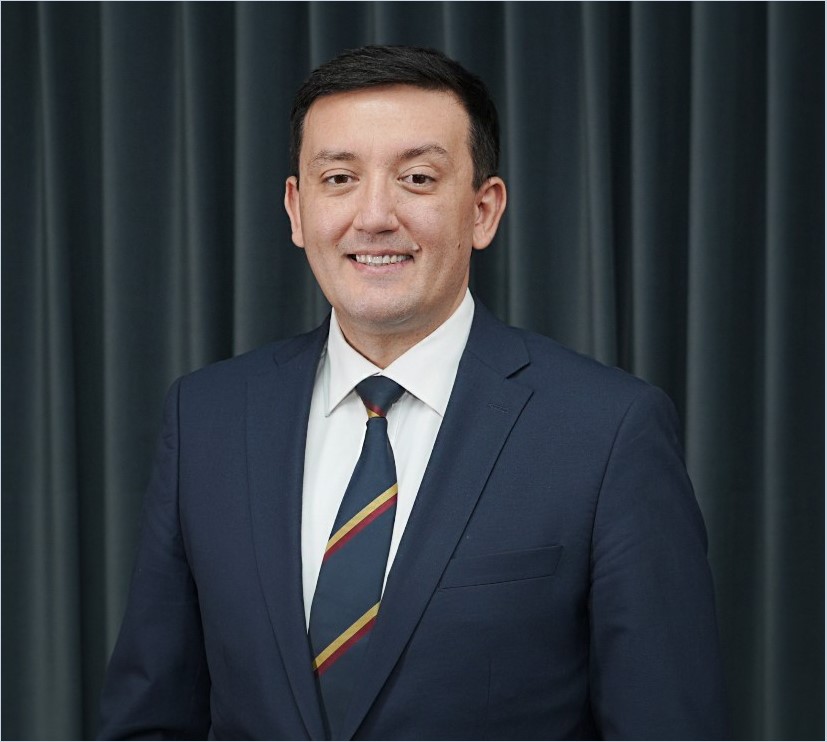



Bobur Mansurovich Bekmurodov was born on January 5, 1985, in Kashkadarya region. His father, Mansur Bobomurodovich Bekmurodov (born in 1953 in Kashkadarya region), is the Head of a Department at the Academy of Public Administration under the President of the Republic of Uzbekistan. His mother, Matonat Ali qizi Bekmurodova, was born in 1960 in the Republic of Azerbaijan.
In 2008, Bobur Bekmurodov graduated from the Uzbek State World Languages University holding a degree of Translator-Philologist.
In 2010, he obtained a second higher education degree in Economics from the Tashkent State University of Economics.
From 2005 to 2006, he was a student of the U.S. “Partnership for Academic Development” Program in Uzbekistan.
In 2018, he completed the John Smith Fellowship Program (United Kingdom).
Career
2006-2007: Specialist in the Investment Projects Department and 2nd-category specialist in the Marketing and Customer Policy Department at “Ipak Yo‘li” Bank.
2007-2011: Competition coordinator and Coordinator of Regional Divisions of the “Kelajak Ovozi” Youth Initiatives Center.
2011-2013: Director of the Republican Youth Employment Assistance Center.
2013-2015: Director of Corporate Development at Creative Financial Solutions.
2015-2017: Founder of "Mega Venture" LLC Joint Venture.
Chief Coordinator and Deputy Executive Director at the "Development Strategy" Center.
2018-2020: Member of the Mirzo-Ulugbek District Council of People’s Representatives.
2019-2020: Executive Director and Deputy Chairman of the Nationwide Movement "Yuksalish".
July 27, 2020 – present: Chairman of the Nationwide Movement "Yuksalish".
In December 2019, he was elected as a Member of the Legislative Chamber of the Oliy Majlis of the Republic of Uzbekistan from the Liberal Democratic Party of Uzbekistan, representing the 126th Beshkent Electoral District (Kashkadarya region) in the parliamentary elections.
As MP and Chairman of the "Yuksalish" Movement, he has worked on developing laws and other legal documents, concepts, and programs aimed at the socio-economic and socio-political development of Uzbekistan. He is also a member of the Committee on Democratic Institutions, Non-Governmental Organizations, and Self-Governing Bodies in the Legislative Chamber of the Oliy Majlis.
Since January 2020, he has been a member of the Commission for Managing Assets of the Public Fund for Support of Non-Governmental Organizations and Other Civil Society Institutions under the Oliy Majlis.
Since 2020, he has also been a member of the National Council for Combating Corruption and the Gender Equality Commission of the Republic of Uzbekistan.
Statements
The leader of the “Spravedlivaya Rossiya” Party, Mironov, questioned how appropriate it is for partner countries within the framework of the Eurasian Economic Union (EAEU) that Uzbekistan, along with Kazakhstan and Kyrgyzstan, has established criminal liability for its citizens participating in Russia's "special military operation."
In response, Bobur Bekmurodov stated: "In our opinion, instead of expressing negative views on this matter, Mironov should focus on working with his own legislation.
First of all, the Russian Federation itself has criminal liability for mercenary activity. Article 359 of the RF Criminal Code provides for criminal responsibility for mercenary actions. It defines mercenary as actions motivated by material interest of a person who is not a citizen of the state involved in the military conflict and who does not permanently reside in that state.
Additionally, Uzbekistan’s foreign policy is based on the principle of non-use of force or the threat of force, along with others.
Article 154 of Uzbekistan’s Criminal Code, which establishes criminal liability for mercenary activity to participate in armed conflicts or military actions in foreign states, was adopted in 1994.
Furthermore, Article 154-1, which establishes criminal liability for Uzbek citizens entering the military service, security, police, military judicial bodies, or other similar bodies of foreign states, was introduced in 2003.
Uzbekistan is a sovereign country, and we do not adapt our legislation to suit the military situations of other states, nor do we adopt laws convenient for others.
Uzbekistan pursues a peaceful foreign policy in its relations with other countries and international organizations," Bekmurodov added.
Regarding the escalation of the situation in Gaza in 2023, Bobur Bekmurodov commented: "The further aggravation of the situation in the Middle East is the result of the bias of large countries.
Nearly 1,000 people died as a result of the bombing of the Al-Ahli hospital in Gaza.
Undoubtedly, this is a violation of international law and universal human values. The deaths of civilians, especially children, can never be justified.
Today, geopolitical actors must take responsibility, instead of competing for political gain or blaming each other, focus on working towards normalizing the situation in the region.
Their rhetorics today should focus not on how to support the war but on how to stop it," Bekmurodov commented.
Bobur Bekmurodov also criticized the regulation developed by the Ministry of Internal Affairs of Uzbekistan that imposes fines or 15 days of administrative arrest for posting photos or videos online aiming at discrediting or insulting law enforcement officers, stating that this norm contradicts the current policy of openness. He emphasized that this could harm the human rights situation in the country.
In response to the threatening statement made by Russian politician Zakhar Prilepin about "occupying Uzbekistan," Bobur Bekmurodov called it "completely unacceptable."
According to him, such views by Russian politicians are undoubtedly worsening the perception of the Russian Federation among Uzbeks.
It further diminishes Russia’s declining reputation. Russian politicians must understand that they cannot make friends amid aggressive attitudes and words. It is precisely such aggressive actions that are damaging relations with friendly countries.
Secondly, we firmly warn that such actions by Zakhar Prilepin may lead to criminal liability under Article 159 of the Criminal Code of Uzbekistan.
Thirdly, the views promoted by Prilepin and other Russian politicians are nothing but an illusion. Whether they like it or not, Uzbekistan is an independent country with strong sovereignty.
Furthermore, on behalf of the Movement, which has nearly 60,000 members, he called on Russian officials to pay attention to and put an end to such aggressive statements towards an allied country.
By making such statements, Prilepin is contradicting Article 79.1 of the Russian Constitution, which stipulates peaceful coexistence with other countries and non-interference in their internal affairs."